
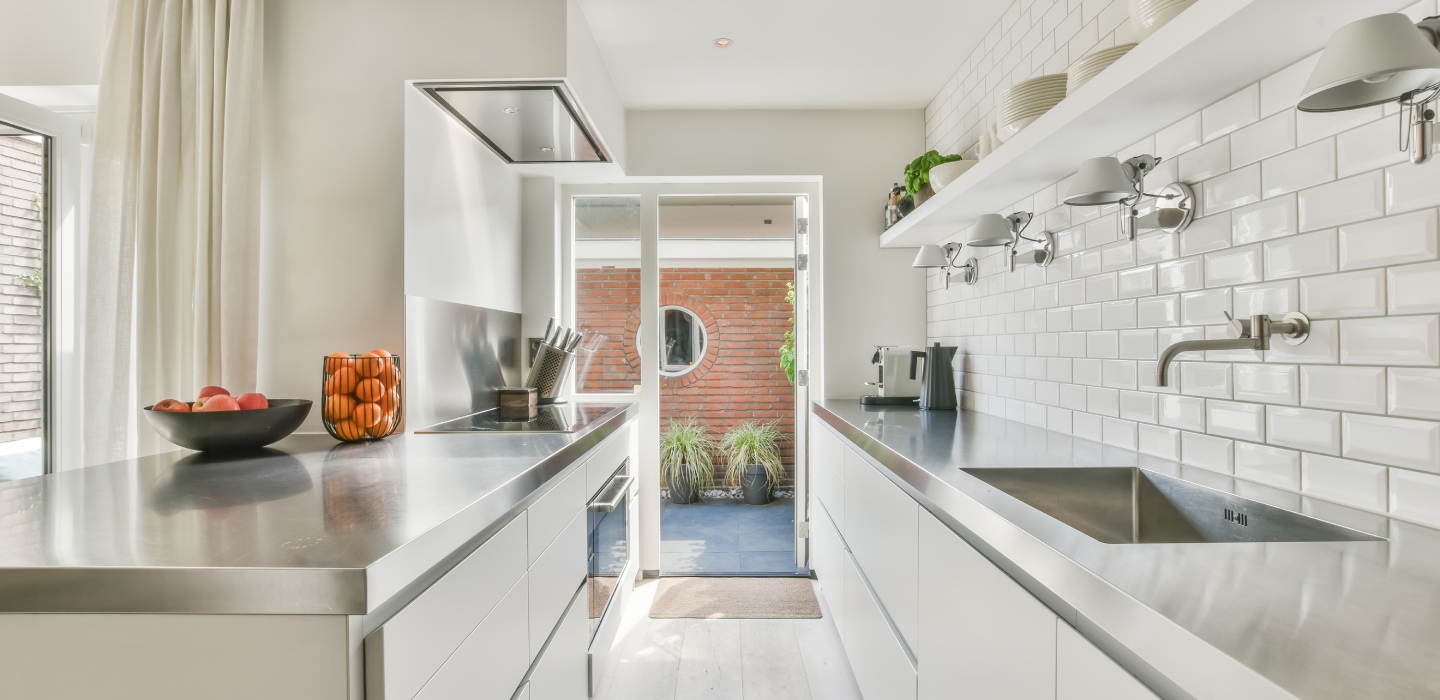
Galley Kitchen Layout: Space-Smart Design for Modern Living
A galley kitchen layout features two parallel countertops with a central corridor, inspired by efficient ship galleys. It places the sink, stove, and fridge in a tight work triangle, reducing movement and making the most of limited floor space—ideal for small or narrow kitchens.
This layout also supports a clean, modern look. With smart zoning and vertical storage like ceiling-high wall cabinets, galley kitchens stay organized and efficient. Whether you’re remodeling or designing from scratch, this layout offers a space-smart solution that blends function with style.
Understanding the Galley Kitchen Concept
A galley kitchen—named after compact ship kitchens—is a streamlined design featuring two parallel countertops with a corridor in between. It emphasizes linear workflow and ergonomic efficiency, reducing unnecessary movement.
By clustering the sink, stove, and fridge (the kitchen work triangle), it boosts productivity even in tight quarters. Whether you’re optimizing a small space or remodeling with intent, understanding this space-efficient layout is step one. Think of it as minimalism in motion—zoned for function, not fluff.
Galley Kitchen Fit: Matching Layout to Lifestyle
A galley kitchen layout isn’t for everyone—but it’s a smart match for many. If you cook solo, live in a compact space, or prioritize function over form, this layout could be a perfect fit. It’s especially ideal for:
Small households or couples
Urban apartments and narrow homes
Renovations with limited floor space
Homeowners focused on efficient daily use
It also suits serious home cooks who value focus and flow in the kitchen. By eliminating unnecessary movement and visual clutter, galley kitchens help you stay organized, productive, and streamlined—even in tight quarters.
Galley vs. Other Kitchen Layouts: A Comparative Guide
Still on the fence? Here’s how the galley kitchen stacks up against other common layouts—so you can choose what truly fits your space, habits, and design vision.
Layout | Best For | Watch Out For |
|---|---|---|
Galley | Small homes, apartments, focused cooking | Feels tight with more than one cook |
L-Shaped | Open corners, flexible zoning | Can create dead space without an island |
U-Shaped | Lots of storage and surfaces | Needs a wide footprint, can feel boxed-in |
Open Concept | Entertaining, social cooking | Limited storage, less defined zones |
Island Layout | Large kitchens, multi-use functionality | Requires significant space for clear movement |
Galley kitchens win on efficiency and flow, but they’re not ideal if your kitchen doubles as your hangout zone.
Galley Kitchen Layout: Pros and Cons
Every layout has a trade-off. Galley kitchens shine in efficiency and space-saving, but they’re not built for crowd control. If you cook solo or value function over fluff, it’s a win. Prefer a social kitchen hub? Maybe not your match. Here’s a quick side-by-side to help you decide:
Pros | Cons |
|---|---|
Super efficient workflow – Compact layout minimizes movement | Limited space – Not ideal for large families or multiple cooks |
Great for small spaces – Perfect for apartments, condos, and older homes | Can feel enclosed – Especially if both sides are walled in |
Lower renovation cost – Fewer cabinets and countertops = less spend | Limited social space – Not naturally suited to entertaining |
Easy to organize – Simplifies storage and zoning | Less natural light – Depending on placement in the home |
Timeless appeal – Works with both modern and classic styles | Resale caution – Some buyers may prefer open layouts |
Exploring Galley Layout Variations
Galley kitchens may follow a narrow, streamlined structure—but how that structure takes shape can vary dramatically. Whether you’re working with limited square footage or an open-plan layout, there’s a galley variation that fits your flow, storage needs, and style preferences.
Classic Double-Run Galley – parallel counters
This layout features two opposing counters with a central corridor. It’s the most space-efficient for cooking, with everything within reach and minimal walking required.
Creates a tight work triangle between sink, stove, and fridge
Suits narrow, enclosed kitchens where wall space is maximized
Separates prep and cooking zones for smoother workflow
Ideal clearance: 3–5 feet between counters for easy movement
Great for solo cooks or smaller households who value efficiency over openness.
One-Wall with Return—Semi-Galley with Partial Divider
Designed for open-plan spaces, this layout runs cabinetry along one wall with a short return counter forming an L-shaped nook. It offers a balance of openness and subtle division.
Adds light separation from living or dining areas
Increases counter space without closing off the kitchen
Doubles as a breakfast bar, coffee station, or landing zone
Works well in studios, lofts, and narrow space
It’s flexible, functional, and perfect for small-space multitasking.
Galley Kitchen with an Island—Hybrid for Open-Plan Homes
When space allows, introducing an island to a galley layout blends practicality with social appeal. It breaks the corridor while maintaining linear efficiency.
Adds extra surface area for prep, storage, or seating
Keeps workflow organized with island as a central hub
Ideal for families or entertainers who need multifunctional space
Requires minimum 42” clearance around all sides of the island
Best suited for wider kitchens that want the galley’s structure with more flexibility.
Asymmetrical vs. Symmetrical Designs—When Balance Matters
Not all galleys are evenly split. While symmetry creates a polished, balanced aesthetic, asymmetrical designs often make better use of irregular spaces.
Symmetrical: Equal-length counters and aligned elements for a clean, formal look
Asymmetrical: Adapts to unique wall lengths or constraints without sacrificing flow
Can balance visual weight using consistent cabinetry, lighting, or materials
Ideal for older homes or custom remodels with spatial quirks
Choose based on layout logic, not just visual preference.
Galley Kitchen Layout Ideas
Once you’ve chosen the right galley kitchen ideas, the next step is making it reflect your style. From sleek and modern to warm and rustic, galley kitchens can pack serious personality despite their size. Here are a few design directions to spark your vision:
Modern Minimalist
Clean lines, neutral tones, and handle-less cabinets create a sleek, clutter-free look that emphasizes form and function.
Rustic Retreat
Warm woods, farmhouse sinks, and textured finishes bring a cozy, lived-in charm to narrow galley kitchen spaces.
Bold and Colorful
Deep-toned cabinetry, statement backsplashes, and playful accents turn your galley into a high-style centerpiece.
Scandinavian-Inspired
Light finishes, open shelving, and soft neutrals make the space feel airy, calm, and efficiently organized.
Industrial Chic
Metal accents, exposed elements, and minimalist fixtures give your kitchen an urban edge with practical appeal.
Functional Flow: Designing for Movement and Workflow
Efficiency isn’t just about tight spacing—it’s about the right spacing. A well-planned galley kitchen supports linear workflow, placing the sink, stove, and fridge in a seamless sequence. Here’s how to nail it:
Keep work zones distinct (prep, cook, clean).
Ensure clear pathways, ideally 4 feet wide.
Place frequently used items within easy reach.
Pro tip: Avoid placing the dishwasher and oven directly opposite each other—no one likes a traffic jam at dinnertime. A smart layout keeps you gliding, not shuffling.
Storage Solutions That Make the Most of Tight Spaces
In a galley kitchen, every square inch counts—and smart storage makes all the difference. Here’s how to level up your space economy:
Use pull-out pantry kitchen cabinets and vertical dividers for trays.
Install ceiling-height upper cabinets to max vertical real estate.
Try toe-kick drawers and undershelf baskets for bonus spots.
Opt for multi-use elements like a rolling cart that doubles as prep space. And don’t sleep on wall-mounted rails or magnetic strips—organization can be wall-bound too. Small kitchen, big storage IQ.
Cleaning and Maintenance Tips for Galley Kitchens
Small kitchens look messy fast—but they’re also easier to clean if you’ve got a system. Here’s how to stay ahead of the clutter:
Wipe daily: Keep counters and cabinet fronts clear and clean with quick daily wipe-downs.
Use drawer organizers: Stop small tools and utensils from becoming a jumbled mess.
Install splash guards: Protect walls near your stove and sink with easy-clean backsplashes.
Declutter weekly: Rotate out unused gadgets and expired pantry items.
Add vertical hangers: Pegboards or hooks keep frequently used items off your limited counter space.
A galley thrives when every item has a purpose—and a place.
Making Your Galley Kitchen Feel Bigger and Brighter
Cramped doesn’t have to feel claustrophobic. With a few clever moves, your galley kitchen can feel open and inviting:
Choose light, reflective colors like soft white or pale gray.
Use glass cabinet doors or open shelving to reduce visual bulk.
Maximize natural light—or mimic it with under-cabinet LED strips.
Run flooring and backsplash materials lengthwise to elongate the space.
Pro Tip: Mirror your backsplash or use high-gloss tiles in a narrow galley kitchen. A reflective backsplash can trick the eye into thinking the room doubles. Think illusionist, not minimalist.
Style Meets Function: Aesthetic Upgrades with Impact
Just because it’s compact doesn’t mean it can’t be stunning. Elevate your galley with upgrades that blend beauty and utility:
Matte black fixtures add modern edge.
Slim-profile appliances keep things sleek and unobtrusive.
Bold backsplashes (think geometric tile or marble slab) create instant impact.
Floating shelves balance openness with display potential.
Texture and contrast go a long way. Mix warm woods with cool metals, or inject personality through patterned runners and artisan lighting. A small space with style swagger? That’s the galley way.
Common Mistakes to Avoid
Designing a galley kitchen? Dodge these pitfalls to keep form and function in sync:
Overcrowding counters – Less is more in tight zones.
Blocking the work triangle – Keep the sink, stove, and fridge accessible.
Ignoring lighting – Bad light = bad vibe.
No landing zones – Always leave space next to cooktops and sinks.
Oversized appliances – Choose compact, kitchen-scaled models.
And don’t forget: skipping professional advice can cost more in the long run. A little planning now avoids a lot of redoing later.
Expert Tips for First-Time Remodelers
Remodeling your first galley kitchen? Welcome to the (very rewarding) puzzle. Here are a few expert tips:
Start with a layout sketch—even a napkin draft helps.
Prioritize workflow overlooks—but don’t neglect either.
Invest in quality lighting—task, ambient, and accent layers.
Use mock-ups or AR apps to visualize changes.
Ask: “What do I reach for daily?” and design around that.
Remember, compact kitchens demand intentionality. Every choice counts, so plan small, think big, and don’t be afraid to ask for help.
Explore More Kitchen Layouts
Looking for the perfect layout beyond the galley? Check out these other popular kitchen designs:
Each layout offers unique advantages depending on your space, style, and cooking needs.
Galley Kitchen Layout FAQ
What is the main advantage of a galley kitchen layout?
The biggest benefit is efficiency. With two parallel counters and a compact corridor, everything is within reach, making cooking faster and movement minimal—especially valuable in small spaces.
How wide should a galley kitchen be?
Ideally, there should be 90 to 150 cm (3 to 5 feet) of space between the two counters. This allows for easy movement without making the space feel cramped.
Is it possible to add an island to a galley kitchen?
Yes, but only if the space is wide enough—generally at least 13 feet. In such cases, adding an island can provide extra prep space and seating while maintaining the galley’s linear efficiency.
How can I make a galley kitchen feel more open?
Use light colours, reflective materials, glass-front wall cabinets, and open shelving. Good lighting and minimal clutter also help create a more spacious, airy feel.
Are galley kitchens outdated?
Not at all. They’re still popular for their practicality, especially in urban homes or compact layouts. With modern finishes and smart storage, galley kitchens continue to feel current and stylish.
Final Takeaway: Galley Kitchen Layout That Works
A smart galley kitchen layout maximizes floor space, streamlines workflow, and delivers timeless functionality in even the most compact homes. Whether you’re starting from scratch or updating an existing space, getting the layout right is everything.
Thomas Matthew Kitchens specializes in designing efficient, stylish galley kitchens—helping you make the most of every inch with custom cabinetry, smart storage, and expert planning tailored to your needs.
Ready to transform your kitchen?
Call us at 01202152121
Book a free design consultation online
Start Your Project Here